Who’s Selling? Here’s The Demographic Driving The Bitcoin, Ethereum, And Dogecoin Price Crash
Recent data has revealed the demographics of sellers driving the Bitcoin, Ethereum, and Dogecoin crash. The index also continues to drop further in the red, which strengthens the case of where exactly the sell pressure is coming from.
The Demographic Behind The Bitcoin, Ethereum, And Dogecoin Price Crash
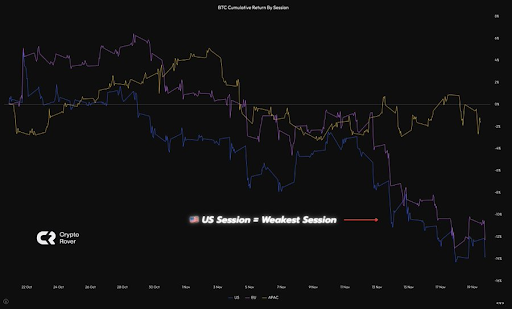
In an , crypto pundit Crypto Rover noted that the U.S. session has been the weakest trading session so far this month. The pundit further shared an accompanying chart, which showed that BTC has suffered a loss of around 12% in the U.S. session since the start of November, also leading to the .
Meanwhile, the EU has had the second-weakest session after the U.S., with Bitcoin dropping around 12% in this session since the start of this month. The Asian session has been the least volatile, with , recording a drawdown of only about 2% since the start of November. Ethereum, Dogecoin, and altcoins have also been stable during the Asian trading session.
Crypto pundit Bossman also indicated that the U.S. was responsible for most of the sell pressure that is driving the Bitcoin, Ethereum, and Dogecoin crash. In an , he noted that every single American session is marked by relentless selling for hours. Meanwhile, the Asians wake up, buy it all back, and then the Americans wake up, and the selling begins again.
Notably, the Bitcoin, Ethereum, and Dogecoin prices record increased volatility whenever the U.S. stock market opens, with market commentator it to the ‘10 am slam’ by market algos. This indicates that institutional investors are heavily contributing to the market crash. This is evident in the significant outflows recorded by in recent times. These funds have recorded five daily net outflows over the last seven days, according to .
Coinbase BTC Premium Index In The Red
shows that the Coinbase Bitcoin premium index is in the red, further confirming that most of the sell pressure driving the BTC, Ethereum, and Dogecoin crash is coming from the U.S. Typically, a negative premium indicates that on Coinbase is lower than the average global price, which signals weak demand from U.S. investors.
Crypto researcher that Bitcoin and Ethereum are roughly 10 days into a derisking event by U.S.-based entities, likely a combination of ETF users and large private, ultra-high-net-worth individuals. He further remarked that this places the market near the end of the selling episode based on historical data.
Soska opined that the first of a near-term bottom would be a mean reversion of the from its current level of around -$110 back to a more normal level range of around $40.
At the time of writing, the Bitcoin price is trading at around $85,000, down over 6% in the last 24 hours, according to from CoinMarketCap.