El Salvador’s IMF Deal Tests Its Bitcoin Reserve Strategy
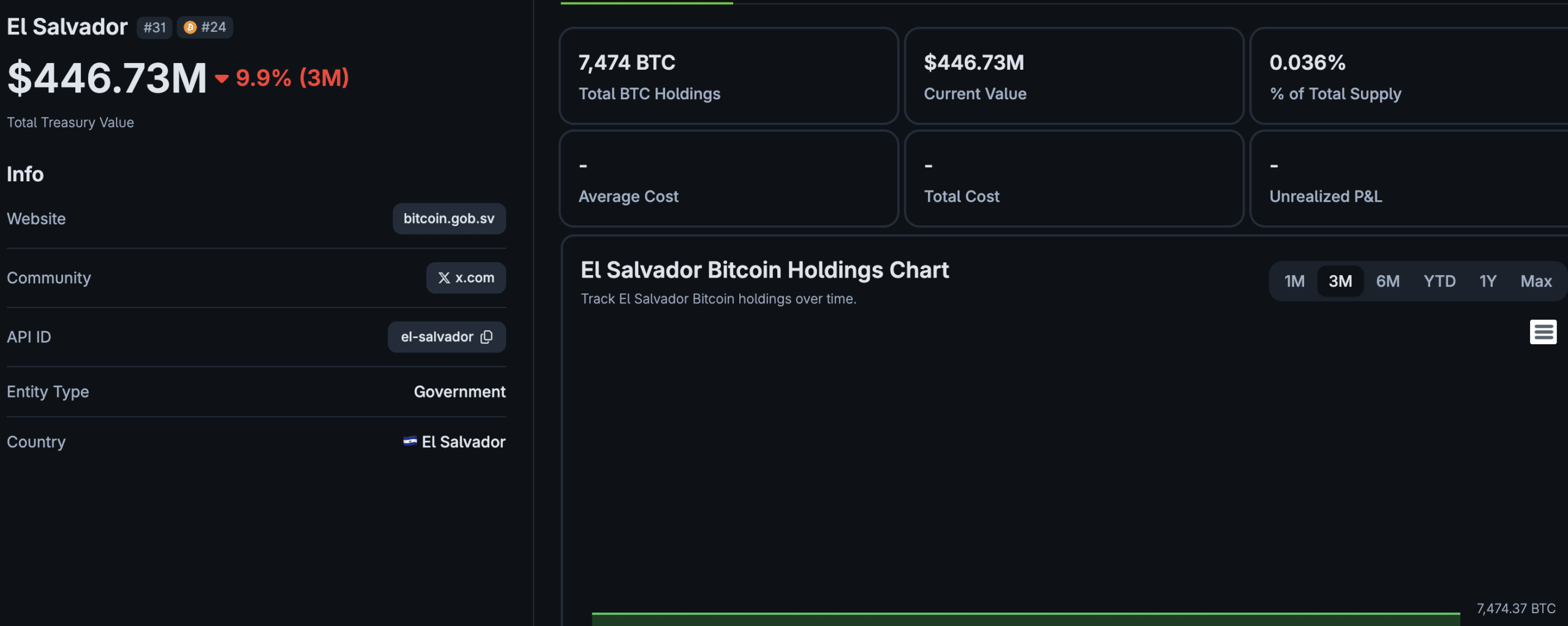
El Salvador’s Strategic Bitcoin Reserve is back under the microscope, and the timing is uncomfortable. lists the country’s government holdings at 7,474 BTC, worth approximately $446M as of June 29, 2026, even as Bitcoin trades around $59,000 to $60,000 after a near-19% drop over 30 days.
The core tension is straightforward: El Salvador’s public one-BTC-a-day accumulation narrative is running directly into an IMF program condition that sets a zero ceiling on new voluntary public-sector Bitcoin purchases.
This look at El Salvador’s Bitcoin dealings comes as BTC/USD dropped back under $60,000 overnight, a -1% loss that has prompted analysts to make fresh $50,000 calls if $60K can’t be reclaimed in quick order.
()
Bitcoin Reserve News: What the IMF’s Zero Ceiling Actually Means
The El Salvador IMF deal – a 40-month Extended Fund Facility (EFF) approved on February 26, 2025, includes a continuous quantitative performance criterion with two hard limits: no voluntary BTC accumulation by the public sector, and no public-sector BTC-denominated or BTC-indexed debt or tokenized instruments.
The IMF also removed Bitcoin’s compulsory legal-tender status under the amended Bitcoin Law, making private-sector acceptance voluntary and taxes payable only in US dollars, as confirmed in an .
The reserve has grown from roughly 5,968 BTC when the program was formalized in December 2024 to 7,474 BTC today – an increase of approximately 1,700 BTC that sits awkwardly against a letter of intent in which El Salvador’s central bank and finance ministry stated no additional BTC had been purchased post-agreement.
IMF spokesperson Julie Kozack offered an explanation in July 2025, stating that apparent increases in the Strategic Bitcoin Reserve Fund reflect “movements across various government-owned wallets,” not net new market purchases by the public sector.
That accounting distinction is central. A sovereign Bitcoin reserve can show a larger balance in a single public-facing wallet or on a tracker like BitcoinTreasuries without technically breaching a no-accumulation commitment, provided the total BTC held across all government-controlled addresses remains flat.
The problem is that the public-facing number keeps climbing, and the IMF’s wallet-consolidation explanation has to be reapplied each time the tracker ticks upward.
JUST IN
El Salvador's 7,696 BTC reserve faces an accounting reckoning as new IMF pressure demands it stay legible through drawdowns, wallet scrutiny, and program conditions.
— Moby Media (@mobymedia)
DISCOVER:
Sovereign Bitcoin DCA Is Not ETF Demand
The market backdrop sharpens the question. US spot Bitcoin ETFs recorded roughly $5.94Bn in outflows over six consecutive weeks, a signal that institutional demand channels can cool quickly when prices fall.
as market confidence has weakened, raising questions about the durability of leveraged BTC accumulation strategies.
El Salvador’s Bitcoin DCA approach differs structurally from both. ETF investors can redeem shares. Corporate treasuries can refinance or issue equity.
A sovereign reserve has to coexist with budget targets, external creditors, and public accounting rules, and, in El Salvador’s case, with an active IMF program.
That insulation from daily redemption flows can make sovereign Bitcoin accumulation more durable than ETF demand during a drawdown. It can also make it more fragile, because the policy is harder to unwind quietly.
face the same structural constraint: the reserve must remain legible to lenders, citizens, and markets simultaneously.
The Next IMF Review Is the Real Test
FACT: EL SALVADOR HAS NOW BOUGHT OVER 17O SO FAR THIS YEAR
IT BUYS 1 BTC EVERY DAY AND HAS NEVER SOLD A SINGLE ONE
WHILE YOU'RE SCARED, NATION-STATES ARE BUYING THE DIP
— The Bitcoin Historian (@pete_rizzo_)
El Salvador’s one-BTC-a-day narrative continues to circulate. Pete Rizzo’s June 26, 2026, post on X claimed that 170-plus BTC were bought in 2026 alone, and that the country retains its position as one of the largest publicly disclosed sovereign Bitcoin reserve holders. The political value of that signal is clear.
The fiscal risk is equally clear: if future IMF reviews cannot reconcile the rising on-chain balance with the wallet-consolidation explanation, the program’s disbursements from the $1.4Bn facility could be at risk.
alongside broader IMF compliance scrutiny, and a 19% monthly drawdown is precisely the kind of environment that tests whether a Bitcoin accounting framework built on wallet-consolidation arguments holds up under repeated examination.
If the next review produces a consistent picture, public tracker, government statement, and IMF assessment all pointing to unchanged total public-sector holdings, then El Salvador’s contained Bitcoin position survives the stress test.
If the numbers keep diverging, what looked like disciplined sovereign DCA starts to look like an unresolved accounting dispute with the country’s primary external lender.
EXPLORE:
Follow For the Latest Market Updates and For Daily Expert Market Analysis.