Goldman Sachs Files for a Bitcoin Income ETF: What It Means for Retail Investors
Goldman Sachs filed for a Bitcoin Premium ETF on April 14, 2026, an options-based fund designed to generate regular income for investors rather than simply track Bitcoin’s price. The filing marks one of Wall Street’s most structurally novel entries into crypto products yet.
The detail most headlines are missing, though, is that this is not a spot Bitcoin ETF. It’s a fundamentally different type of product, one that trades Bitcoin’s upside potential for a stream of income. Those two things are not the same, and the distinction matters enormously if you’re trying to figure out whether this belongs in your portfolio.
So what does Goldman actually filing this mean for retail investors? Let’s unpack the mechanics before drawing any conclusions.
JUST IN: GOLDMAN SACHS FILES FOR BITCOIN PREMIUM INCOME ETF
Goldman Sachs has filed to launch a Bitcoin Premium Income ETF, signaling continued expansion of institutional yield-style investment products.
— Coin Bureau (@coinbureau)
DISCOVER:
What the Goldman Sachs Bitcoin Premium ETF Actually Is
Goldman’s filing describes a fund that would hold at least 80% of its assets in Bitcoin-exposed investments, primarily spot Bitcoin ETFs and derivatives tied to them. That’s the Bitcoin exposure part. The income part works differently.
JUST IN: GOLDMAN SACHS FILES FOR BITCOIN PREMIUM INCOME ETF
Goldman Sachs has filed to launch a Bitcoin Premium Income ETF, signaling continued expansion of institutional yield-style investment products.
— Coin Bureau (@coinbureau)
To generate yield, the fund sells options contracts tied to those Bitcoin ETFs. Think of it like owning a house and renting it out: you still own the house, but you’re collecting rent in exchange for giving someone else the right to buy it at a set price. In this case, Goldman collects what’s called a premium, a fee paid by traders who want leveraged Bitcoin exposure, and passes that income to fund investors.
This strategy is known as a covered call, and it’s well-established in traditional markets. Goldman isn’t inventing something exotic here. It’s applying a decades-old yield strategy to a new underlying asset.
Bloomberg Senior ETF Analyst Eric Balchunas noted on X that Goldman’s structure, a ’40 Act filing using a Cayman Islands subsidiary, could actually give it a regulatory timing advantage over BlackRock’s similar filing, which uses a different structure. “Goldman may sense an opportunity to leap frog them,” Balchunas wrote. The fund could potentially launch around mid-June 2026 if the standard 75-day SEC review timeline holds.
DISCOVER:
How This Differs From Owning Spot Bitcoin or a Spot ETF
Owning spot Bitcoin means you own the asset directly, every dollar Bitcoin gains is yours, and every dollar it loses comes out of your pocket. A spot Bitcoin ETF like BlackRock’s IBIT does the same thing through a brokerage account, without you needing to manage wallets or private keys.
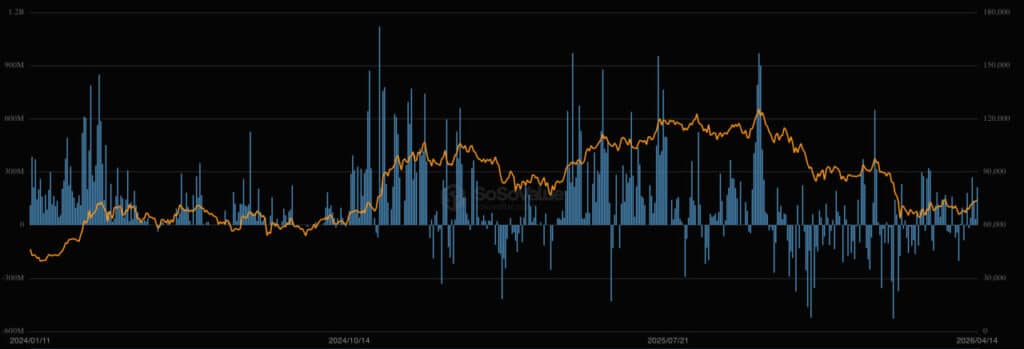
BlackRock’s spot ETF has pulled in $63.8 billion in net inflows since its 2024 debut. That’s pure price exposure.
iShares Bitcoin Trust(IBIT) / Source:
Goldman’s income ETF is built differently. Here’s what changes structurally:
Upside is capped: When you sell a call option, you’re promising to hand over gains above a certain price. If Bitcoin surges 40% in a month, the fund captures only part of that move. The rest goes to the option buyer.
Income replaces appreciation: Instead of riding Bitcoin’s full price swings, investors receive regular premium payments. In stable or slowly rising markets, this can outperform a pure price-tracking strategy. In explosive bull runs, it almost certainly won’t.
You still carry downside risk: The fund holds Bitcoin-exposed assets. If Bitcoin drops sharply, the income from selling options won’t fully offset those losses. The premium cushions the fall, it doesn’t prevent it.
The honest framing: this is a product for investors who want Bitcoin in their portfolio but prioritize yield over maximum upside. That’s not a bad trade-off. It’s just a very specific one. Existing covered-call Bitcoin ETFs like NEOS’ BTCI have already attracted $1 billion in assets under management, so there’s clearly an audience.
DISCOVER:
Follow 99Bitcoins on , , and for more crypto news and analysis.


 JUST IN: GOLDMAN SACHS FILES FOR BITCOIN PREMIUM INCOME ETF